A code of ethics is a set of principles and rules used by individuals and organizations to govern their decision-making process, as well as to distinguish right from wrong. They provide a general idea of the ethical standards of a business or organization. However, people can have their own personal code of ethics as well. Keep reading for a more thorough explanation of a code of ethics, as well as several code of ethics examples.
Professional Codes of Ethics
Several professions have a code of ethics that exists independent of any particular employment. For instance, a doctor or lawyer is always bound by the code of ethics for their profession, regardless of whether they work for a large organization or are in private practice. These codes constitute the basic expectations of these jobs and guide them when making decisions.
The Legal Profession
Lawyers, paralegals and other employees of the legal profession are bound to a general code of ethics. A few of these governing ethics include:
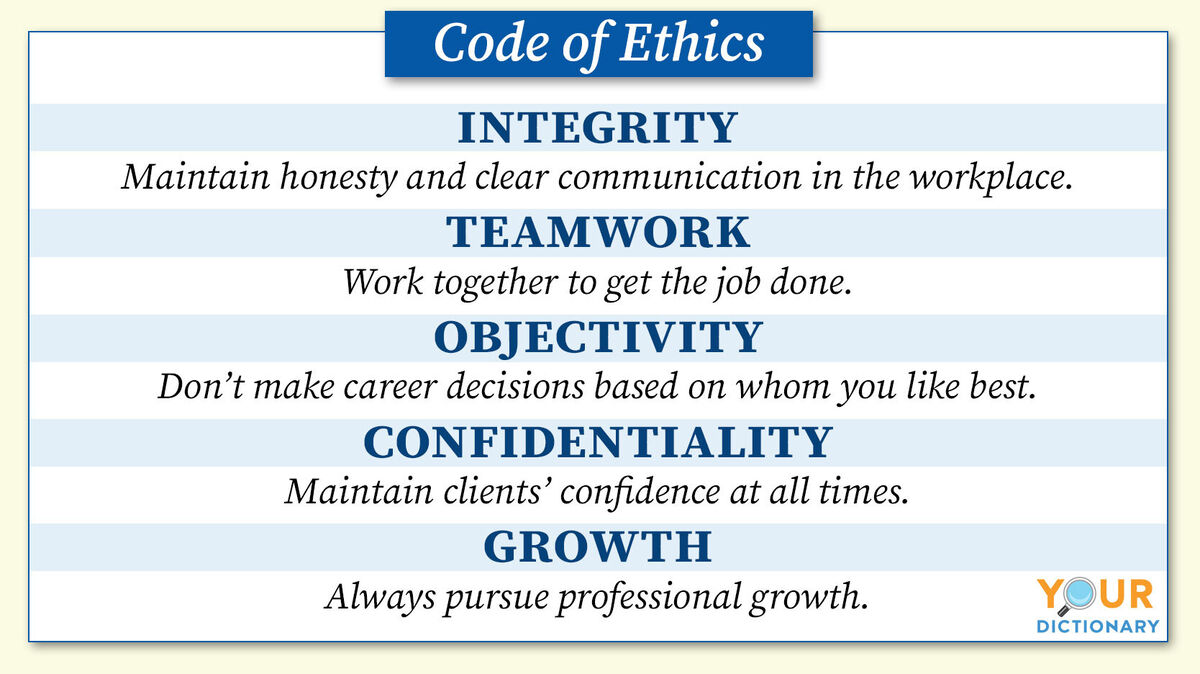
- Confidentiality - Lawyers must maintain their clients' confidence at all times.
- Competence - Legal professionals must represent their clients with a high level of competence.
- Professional Courtesy - Lawyers must treat their colleagues with fairness and courtesy.
The Medical Profession
The American Medical Association imposes a code of ethics on physicians. It addresses everything from interpersonal relationships with other staff members to information on patient care. For instance:
- Trust - Doctors must instill a sense of trust between themselves and their patients.
- Do No Harm - Doctors cannot engage in any activity that would cause harm to their patients.
- Privacy - Doctors cannot share the details of their patients' medical treatments or histories without permission.
The Business World
Corporations and have codes of ethics to help workers decide if certain behaviors are appropriate and acceptable when dealing with clients and outside agencies. Many organizations require employees to attend yearly training on ethics and, in some cases, to sign statements promising to adhere to all ethical guidelines laid out by the company.
Examples of ethics in the business world include:
- Integrity - Employees should maintain honesty and clear communication in the workplace.
- Teamwork - Members of a professional organization should work together to get the job done.
- Objectivity - Employers should not make career decisions based on whom they like best or with whom they have personal relationships.
Teachers and Education
Teachers and other education professionals are role models to their students. Their code of ethics not only protects their students against mistreatment, but it also protects their sense of fairness itself. Some code of ethics examples in education include:
- Consideration - Teachers should put the needs of their students first.
- Growth - Educators need to pursue professional growth.
- Communication - Teachers work with parents as a support team for each student.
Personal Codes of Ethics
Individual codes of ethics can originate from religion, secular philosophy or rules of social behavior derived from upbringing and experience. They are typically in line with the rest of one's society, but one may have stricter or more relaxed personal ethics as well.
Ethical Expectations in Society
Society at large assumes that certain ethics, morals and values can be expected regardless of religion, geographic location or nationality. The classic example is the Golden Rule: "Do unto others as you would have them do unto you." Other examples of societal ethical behavior include:
- Respect - Citizens must respect another's property, choices and lives.
- Loyalty - People put their family and friends' needs before their own.
- Honesty - Individuals tell the truth to community members and authority figures.
Religious Codes of Ethics
Certain codes of ethics, such as religious codes of ethics, apply only to members of select groups. They are based on morals shared by tenets and members of that religion. Examples of religious codes of ethics include the Ten Commandments of Judaism, the Beatitudes of Christianity, the Five Pillars of Islam, and the Noble Eightfold Path of Buddhism.
Some shared ethics in these religions include:
- Value of Life - Do not kill your fellow human.
- Pursue Peace - Avoid violence when possible.
- Do Not Steal - Don't take things that don't belong to you.
Secular Codes of Ethics
Personal codes of ethics do not require religion, however. Immanuel Kant's categorical imperative and the Utilitarian rule of the greatest good for the greatest number are both ethical codes that do not require any religious basis. Some of these ethics may include:
- Sustainable Living - Live in a way that doesn't waste unsustainable resources.
- Care for the Vulnerable - Those who are medically or economically disadvantaged should have priority of care.
- Benefit the Greater Good - Make sure that your decisions help others rather than just yourself.
Code of Ethics vs. Code of Conduct
A code of ethics is only effective if it corresponds to a set of behaviors that uphold those ethics. The terms code of ethics and code of conduct are often used interchangeably; however, there are some key differences between them.
- A code of ethics details the general ethics that a person or employee should uphold.
- A code of conduct details the way that a person or employee should behave in order to uphold the code of ethics.
While a code of conduct may not always correspond to a code of ethics, a code of ethics must have a corresponding code of conduct. For example, if an organization includes honesty in its code of ethics, its code of conduct may include something like "Employees will come to their supervisor with any problems before discussing it with outside members of the team." A business that values safety in its code of ethics would set very specific safety rules in its code of conduct.
The Power of Ethics in the Modern World
Codes of ethics are present at all levels of society, as well as in business and individual behavior. Many are codified in writing and enforced with penalties, while others are more malleable and dependent on the individual's perception of right and wrong. For further study of ethics and their place in the world, have a look at these examples of rights-based ethics.