Alliteration is a literary device that repeats a speech sound in a sequence of words that are close to each other. Alliteration uses consonant sounds at the beginning of a word to give stress to its syllable. This technique plays a crucial role in poetry by lending a strong rhythm and musical structure to any verse. Explore a few famous alliteration poems to see examples of this technique.
Alliteration in Poetry
Alliteration is a poet's tool to bring words together and make patterns in their writing. Several great poets used alliteration in their work. See a few of the greats like William Shakespeare and Edgar Allan and their use of alliteration.
Sonnet 5 by William Shakespeare
William Shakespeare's work frequently featured alliteration. There are several examples in Romeo and Juliet, but his poetry often used alliteration too. For example, in "Sonnet 5," the "b" sound in beauty, bareness and bereft set a romantic tone. In the last line, the "s" substance and sweet provides a soothing rhythm.
"Beauty o'er-snowed and bareness every where:
Then were not summer's distillation left,
A liquid prisoner pent in walls of glass,
Beauty's effect with beauty were bereft,
Nor it, nor no remembrance what it was:
But flowers distilled, though they with winter meet,
Leese but their show; their substance still lives sweet."
The Raven By Edgar Allan Poe
"The Raven" by Edgar Allan Poe uses alliteration in word pairs. In the first three lines of The Raven, there are three examples: weak/weary, quaint/curious and nodded/nearly napping.
“Once upon a midnight dreary, while I pondered, weak and weary,
Over many a quaint and curious volume of forgotten lore—
While I nodded, nearly napping, suddenly there came a tapping,”
Birches by Robert Frost
"Birches" by Robert Frost repeats the "b" sound throughout the first four lines to emphasize the dominant theme of the poem.
"When I see birches bend to left and right
Across the lines of straighter darker trees,
I like to think some boy's been swinging them.
But swinging doesn't bend them down to stay"
Much Madness is divinest Sense by Emily Dickinson
"Much Madness is divinest Sense" by Emily Dickinson uses alliteration of the "m" sound in the title. This is repeated in the poem itself to encourage readers to contemplate what it means to be mad.
“Much Madness is divinest Sense -
To a discerning Eye -
Much Sense -- the starkest Madness -
'Tis the Majority
In this, as All, prevail -
Assent - and you are sane -
Demur - you're straightway dangerous -
And handled with a Chain -”
The Rime of the Ancient Mariner by Samuel Taylor Coleridge
"The Rime of the Ancient Mariner" is Samuel Taylor Coleridge's longest poem, featuring rhythmic groupings of alliteration throughout. In the following excerpt, sun/sea/sea, beat/breast/bassoon, red/rose, and merry/minstrelsy are examples of alliterative devices.
"The ship was cheered, the harbour cleared,
Merrily did we drop
Below the kirk, below the hill,
Below the lighthouse top.
The Sun came up upon the left,
Out of the sea came he!
And he shone bright, and on the right
Went down into the sea.
Higher and higher every day,
Till over the mast at noon—'
The Wedding-Guest here beat his breast,
For he heard the loud bassoon.
The bride hath paced into the hall,
Red as a rose is she;
Nodding their heads before her goes
The merry minstrelsy."
In a Whispering Garden by Thomas Hardy
Thomas Hardy creates rhythm in his poem "In a Whispering Garden" by combining several examples of alliteration, such as the "s" sound in spirit, speaking, spell, spot, splendid, see, and soul. "Gaunt gray gallery" is another alliterative phrase that allows the reader to immediately conjure a visual image of the poem's setting.
"That whisper takes the voice
Of a Spirit, speaking to me,
Close, but invisible,
And throws me under a spell
At the kindling vision it brings;
And for a moment I rejoice,
And believe in transcendent things
That would make of this muddy earth
A spot for the splendid birth
Of everlasting lives,
Whereto no night arrives;
And this gaunt gray gallery
A tabernacle of worth
On this drab-aired afternoon,
When you can barely see
Across its hazed lacune
If opposite aught there be
Of fleshed humanity
Wherewith I may commune;
Or if the voice so near
Be a soul’s voice floating here."
Alliteration in Children's Rhyme Poems
Tongue twisters can be a fun way to introduce children to alliteration, but they can be tricky to get right. Explore a few famous children's rhyme poems that include alliteration.
Peter Piper by John Harris
How quickly can you recite "Peter Piper" by John Harris? Probably not that quickly. It's easy for your tongue to get tripped up on the repeated "p" sound.
"Peter Piper picked a peck of pickled peppers,
A peck of pickled peppers Peter Piper picked;
If Peter Piper picked a peck of pickled peppers,
Where’s the peck of pickled peppers Peter Piper picked?"
Betty Botter by Carolyn Wells
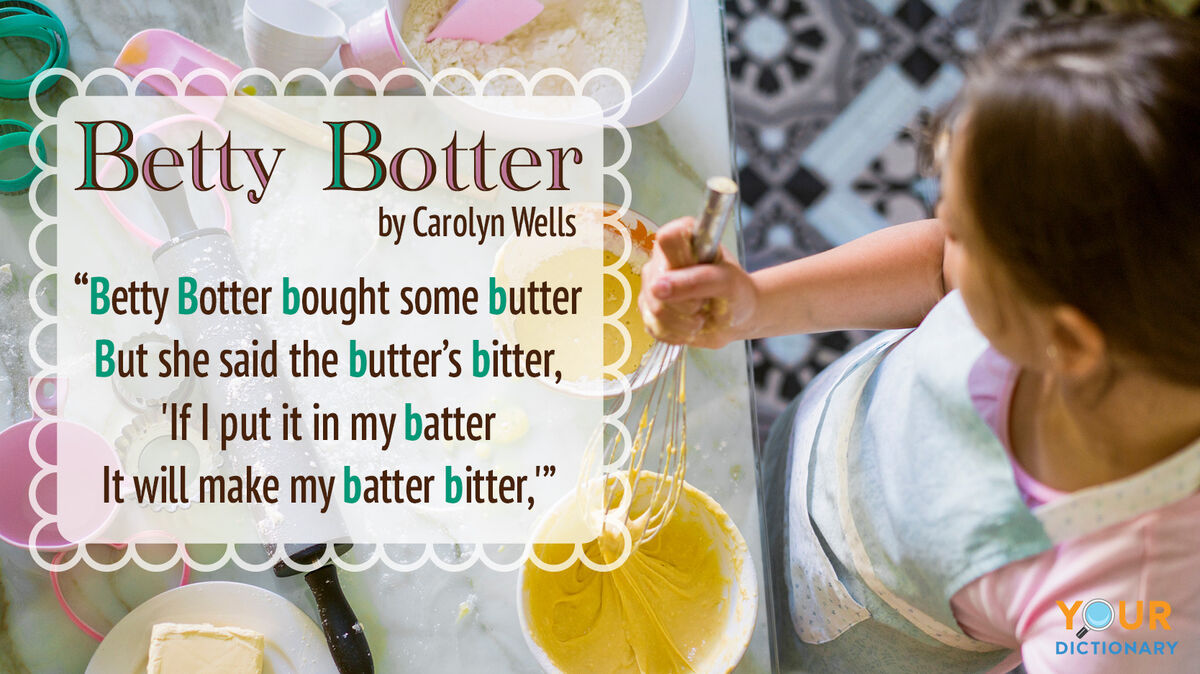
Mother Goose poems typically contain a great deal of alliteration. Poems with alliteration can be easier to memorize, which is why adults are often able to easily recall the nursery rhymes associated with their childhood. Consider the alliteration of the "b" sounds in "Betty Botter" by Carolyn Wells.
"Betty Botter bought some butter
But she said the butter’s bitter,
'If I put it in my batter
It will make my batter bitter,
But a bit of better butter
Will make my batter better.'
So she bought some better butter
Better than the bitter butter,
And she put it in her batter
And her batter was not bitter,
So ’twas better Betty Botter
Bought a bit of better butter."
The Gnome, The Gnat & The Gnu by Shel Silverstein
Author Shel Silverstein frequently used alliteration in his poems for children to create a fanciful tone, even when it meant creating nonsense words. "The Gnome, The Gnat & The Gnu" repeats the "gn" sound throughout the verse.
"I saw an ol’ gnome
Take a gknock at a gnat
Who was gnibbling the gnose of his gnu.
I said, 'Gnasty gnome,
Gnow, stop doing that.
That gnat aint done gnothing to you.'
He gnodded his gnarled ol’ head and said,
'Til gnow I gnever gnew
That gknocking a gnat
In the gnoodle like that
Was gnot a gnice thing to do.'"
Fox in Socks by Dr. Seuss
Famous for his tongue twisters, Dr. Seuss used alliteration to make his books fun to read and listen to. Read too quickly and you could find yourself tripping over your tongue. While you might consider Dr. Seuss's works literature, he used poetic techniques, like rhyme and repetition, to create his works. Therefore, you can also call his words poetry. Check out a famous passage from Fox in Socks and the way it uses alliterations like the/three, flea/flew and breeze/blue, among others.
"Through three cheese trees three free fleas flew.
While these fleas flew, freezy breeze blew.
Freezy breeze made these three trees freeze.
Freezy trees made these trees' cheese freeze.
That's what made these three free fleas sneeze."
Alliteration Makes Poems More Memorable
Alliteration is a creative tool that gives all types of poetry a memorable rhythm when recited. It's a fun way to play with words that brings out the imagination of both writer and reader while appealing to children and adults alike.