If you tell someone “You look like a million bucks,” you’re not saying that they look like a stack of cash. You’re using figurative language to say that they look really good. So why not just say that? What does figurative language add to our conversations and writing — and how many types of figurative language do you encounter every day?
What Is Figurative Language?
Figurative language is non-literal wording that adds creativity or rhetorical meaning to your writing. It invites the reader to use their senses or prior knowledge to understand your meaning.
For example:
- This coffee shop is an icebox!
- She's drowning in a sea of grief.
- She's as happy as a clam.
- I move fast like a cheetah on the Serengeti.
- The sea lashed out in anger at the ships, unwilling to tolerate another battle.
- The sky misses the sun at night.
- I've told you a million times to clean your room!
- Her head was spinning from all the new information.
- She was living her life in chains.
- When she saw the dove soar high above her home, she knew the worst was over.
None of these phrases are literal, but you still understand what they mean. They use your senses or experiences to make a point rather than directly explaining what they mean.
Why Use Figurative Language?
Depending on which figurative language you use, you can create different images or arguments for your reader. It’s all about choosing the correct wording for what you want to say.
- You look like a million bucks. (You look wonderful.)
- You look like an angel. (You look beautiful.)
- You look like something the cat dragged in. (You look terrible.)
- You look like you’ve seen a ghost. (You look terrified.)
- You look like death warmed up. (You look sick.)
- You look like a spring morning. (You look refreshed and healthy.)
- You look like an old mop. (You’re not attractive.)
Examples of Figurative Language: The 9 Types
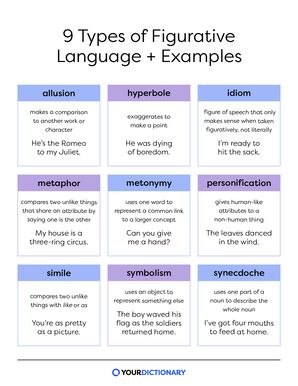
Any time you’re using language that shouldn’t be taken literally, you’re using figurative language. You can group most examples of figurative language into nine different types.
Advertisement
Examples of Allusion
Allusions reference something famous that readers likely know about. They can refer to written works, songs, famous people, historical events, mythological figures, or even television shows.
- He was the Romeo to her Juliet. (Refers to Romeo and Juliet)
- I made a Herculean effort this year. (Refers to the myth of Hercules)
- You always want the forbidden fruit. (Refers to the story of Adam and Eve)
- This job is my white whale. (Refers to Moby Dick)
- Red velvet cake is my kryptonite. (Refers to the Superman comics)
- Cupid’s arrows always seem to miss me. (Refers to the Roman god Cupid)
- Don’t be such a Scrooge this Christmas. (Refers to A Christmas Carol)
- Make sure not to tell he-who-shall-not-be-named. (Refers to Harry Potter)
Advertisement
Examples of Hyperbole
When a writer exaggerates something to make a point, it's called a hyperbole (hy-PER-bow-lee). Hyperbole in literature adds color and depth to a character and to an argument.
- You snore louder than a freight train!
- It's a slow burn. I spent a couple of weeks there one day.
- He was dying of boredom.
- I had to walk 15 miles to school in the snow, uphill, in bare feet.
- You could've knocked me over with a feather.
- I’ve been sitting in traffic half my life!
- Her head was killing her.
- We’ve been waiting for you all day.
Examples of Idioms
Idioms are figures of speech that don’t make any sense on their own, but they make perfect sense to native English speakers. When an idiom is overused or very common, it’s also known as a cliché.
- Stop beating a dead horse.
- We’ve bitten off more than we can chew.
- That train has left the station.
- I heard the news straight from the horse’s mouth.
- Let’s throw caution to the wind.
- He’s as dead as a doornail.
- It’s raining cats and dogs outside.
- I’m ready to hit the sack.
- It’s no skin off my nose.
- Why are you giving me the cold shoulder?
Advertisement
Metaphor Examples
Metaphors make comparisons between two things that share one attribute. They state that one thing is another thing. But like all figurative language, metaphors aren’t literal. You need to think about each thing to figure out how they are alike.
You’re likely to find metaphors in poems and poetic language, but they also appear in everyday speech.
- Ellen’s job is a dead-end street.
- My house is a three-ring circus.
- He has a heart of stone.
- You’re a breath of fresh air.
- The scenic view from my window is a gorgeous painting.
- Marion wears her heart on her sleeve.
- You are a ray of sunshine.
- America is a melting pot.
Metonymy Examples
In metonymy (met-ON-oh-me) a word becomes linked with a larger concept to the point where it can stand for that concept.
- You can't fight the power of the crown.
- Bring a dish to pass.
- Can you give me a hand?
- Please lend me your ear.
- That happens all the time on Wall Street.
- The actor’s goal has always been Hollywood.
- The pen can be a mighty tool.
- The young couple took a trip to the altar.
Advertisement
Personification Examples
Giving human-like attributes to a non-human thing is personification. (Note that personification is different from anthropomorphism, which allows non-human things to literally act as humans, and is not figurative language.)
- Opportunity knocked at his door.
- The sun greeted me this morning.
- Dancing stars filled the sky.
- Vines wove their delicate fingers together.
- The radio suddenly stopped singing.
- An orchestra of crickets played their melody.
- My car engine grumbled before rumbling to life.
- The wind howled outside the window.
Simile Examples
A simile compares two things using the words like or as. Unlike metaphors, they explicitly state the quality they’re comparing between two things.
- She’s as busy as a bee.
- My room is as clean as a whistle.
- The child is brave as a lion.
- We stood out like a sore thumb.
- It was as easy as shooting fish in a barrel.
- My mouth was as dry as a bone.
- He’s like a bull in a china shop.
- She's as prickly as a porcupine.
Advertisement
Symbolism Examples
In writing, symbolism occurs when a word has its own meaning but represents something entirely different. You’ll find literary examples of symbolism in nearly everything you read.
- As he stormed out of the house, the last leaf fell from the dead oak tree.
- The black night crept upon us, and I felt the coldness of death.
- Joanie watched the bird in the cage fight for its freedom against the bars.
- “Go away!” she yelled as a clap of thunder roared above us.
- The rain washed over our town, filling our soil and lifting our spirits.
- A rainbow stretched across the sky as we embraced after our fight.
- The worried mother robin fussed over her nest as I watched my daughter step into her kindergarten classroom.
- A dark cloud settled over the house after Dad moved away.
Advertisement
Synecdoche Examples
A synecdoche (sin-ECK-doh-key) uses part of a noun to represent the whole thing. It can also use the whole noun to represent part of a noun.
- I'm paying with plastic.
- We need to get a head count.
- Rachel wore new threads to the party.
- Grab me a Kleenex.
- I need a Band-aid.
- My mom is the brains of our family.
- Did you get new wheels?
- The world is against me.
You’ve Hit the (Figurative) Jackpot
Using figurative language is like finding buried treasure. (See what we did there?) Once you know how to use the different types of figurative language, your writing will engage readers even better.
But figurative language isn’t just a writing tool — it can be an effective way to make your point in different types of writing. You can even use figurative language as a rhetorical device to convince your audience to agree with you — for better or for worse.
