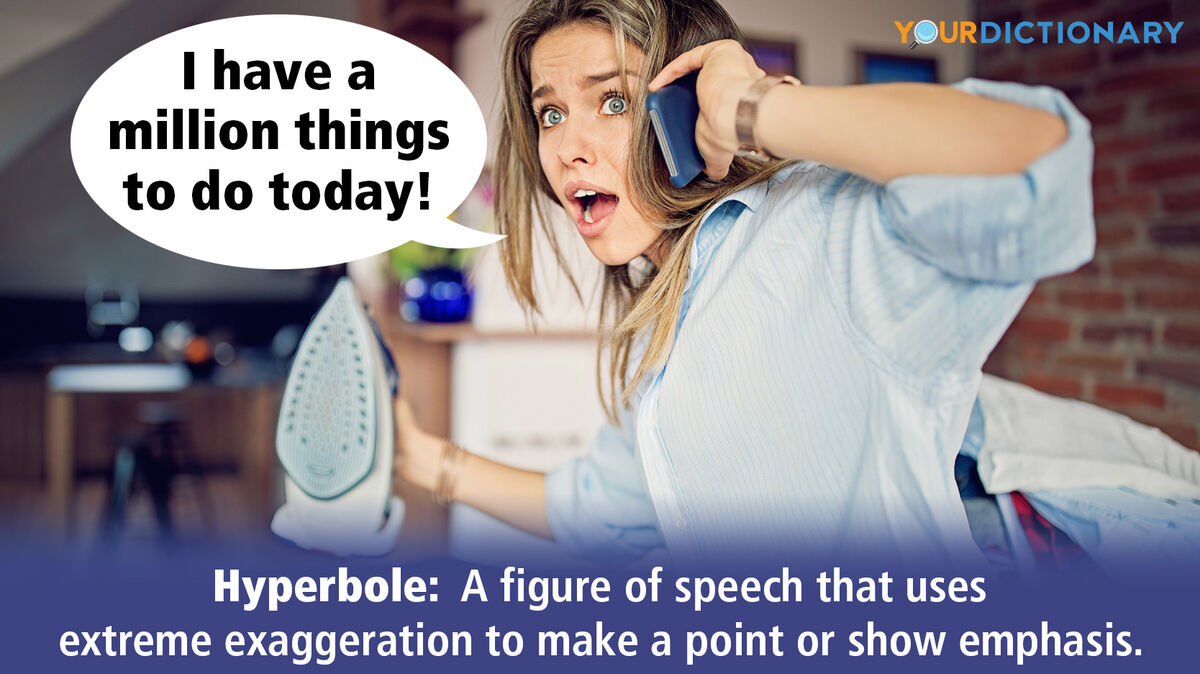
The word hyperbole, from a Greek word meaning “excess,” is a figure of speech that uses extreme exaggeration to make a point or show emphasis. It is the opposite of understatement. You can find hyperbole examples in literature and everyday speech
Hyperbole Definition
There is exaggeration, and then there is exaggeration. That extreme kind of exaggeration in speech is the literary device known as hyperbole.
Take this statement for example:
I’m so hungry, I could eat a horse.
In truth, you wouldn’t be able to eat a whole horse. But you use the phrase to show people you’re extremely hungry.
Hyperbole is used in literature, rhetoric and everyday speech. You wouldn’t want to use it in nonfiction works, like reports or research papers. Still, it’s perfect for creative writing and communication, especially when you want to add color to a character or humor to a story.
Hyperbole vs. Metaphor and Simile
How to Use Hyperbole to Add Emphasis
Hyperbole in writing and speech can add a dramatic or serious effect to a statement depending on how it’s used. To make sure your hyperbole adds the emphasis you are looking for, keep a few things in mind:
What is your exaggeration describing: a feeling or quantity?
Does it make sense and sound natural?
Now that you know what to think about when adding hyperbole to your work, see how hyperbole adds emphasis.
Without hyperbole - This game is taking a long time.
With hyperbole - This game is taking forever.
Without hyperbole - This helmet is hurting my chin.
With hyperbole - This helmet is killing me.
In truth, the game isn’t actually taking forever, and the helmet isn't killing anyone, but adding that wording is more creative. Now explore a few more everyday examples.
Hyperbole in Everyday Use
In these common, everyday examples of hyperbole, you’ll see the sentiment isn’t realistic, but it helps to stress the point.
I’ve told you to clean your room a million times!
It was so cold; I saw polar bears wearing hats and jackets.
She’s so dumb; she thinks Taco Bell is a Mexican phone company
I have a million things to do today.
When I was young, I had to walk 15 miles to school uphill, in the snow.
I had a ton of homework.
If I can’t buy that perfect prom dress, I’ll die!
The car went faster than the speed of light.
His new car cost a bazillion dollars.
We’re so poor we don’t have two cents to rub together.
That joke is so old; the last time I heard it, I was riding a dinosaur.
They ran like greased lightning.
He's got tons of money.
You could have knocked me over with a feather.
Her brain is the size of a pea.
My geography teacher is older than the hills.
Hyperbole Examples
While you use hyperbole in everyday speech all the time, it’s also a great literary device for songs, speeches and advertising. See a few successful examples of hyperbole.
Hyperbole in Speeches
When hyperbole is carefully placed into a speech, it can help you really punch your points. A tiny bit of exaggeration may be enough to perk up the ears of your audience.
"I think this is the most extraordinary collection of human talent, of human knowledge, that has ever been gathered at the White House — with the possible exception of when Thomas Jefferson dined alone." - White House dinner honoring Nobel Prize winners, President John F. Kennedy
"So first of all, let me assert my firm belief that the only thing we have to fear is fear itself." - First Inaugural Address, Franklin Delano Roosevelt
“That year, 1967, the Dallas Cowboys had 137 rookies in training camp. Gil Brandt was signing everybody that could walk. Only five made the team that year, and I was one of the five." - Pro Football Hall of Fame Induction Address, Larry Rayfield Wright
"Please sit down because having produced nine million award shows, I know the producer's up there saying, 'Hurry, say thanks fast.'" - Daytime Emmy Award Acceptance Address, Dick Clark
Hyperbole in Songs
Similar to a well-delivered speech, hyperbole can help paint a vivid picture or express a strong emotion in the lyrics of a song.
“California girls/ We're unforgettable/ Daisy Dukes/ Bikinis on top/ Sun-kissed skin/ so hot/ We'll melt your popsicle” - California Gurls, Katy Perry
“Now there's just no chance/ with you and me/ there'll never be/ don't it make you sad about it?/ Cry me a river/ Cry me a river” - Cry Me a River, Justin Timberlake
“I would fly to the moon and back/ if you'll be If you'll be my baby/ Got a ticket for a world where/ we belong/ So would you be my baby” - To the Moon and Back, Savage Garden
“'Cause tonight for the first time/ Just about half-past ten/ For the first time in history/ It's gonna start raining men/ It's raining men, Hallelujah./ It's raining men, amen” - It’s Raining Men, The Weather Girls
"But I would walk 500 miles/ And I would walk 500 more/ Just to be the man who walks a thousand miles/ to fall down at your door” - I’m Gonna Be (500 Miles), The Proclaimers
Hyperbole in Advertising
If used properly, hyperbole can encourage consumers to buy products. There has been limited research into this area, but according to a 2007 study by Mark A. Callister, Ph.D. & Lesa A. Stern, Ph.D., The Role of Visual Hyperbole in Advertising Effectiveness, found that "hyperbolic ads produce more ad liking than nonhyperbolic ads."
Examples of hyperboles in advertising include:
"Adds amazing luster for infinite, mirror-like shine." (Brilliant Brunette shampoo)
"It doesn't get better than this." (Oscar Meyer)
"The best a man can get." (Gillette)
"Mints so strong they come in a metal box." (Altoids)
Accentuate and Exaggerate
Remember, hyperbole is over the top and not meant to be taken literally. Keep your ears open for examples of these exaggerations in every source, from poetry and plays to everyday conversations and commercials. Try using hyperbole yourself to show contrast or inject feeling and humor into your writing. And, while you’re at it, enjoy some examples of hyperbole in literature. When used appropriately, a hyperbole’s effect is purposeful and emphatic, causing the reader to pay attention. Just be careful not to overdo the overstatement!