A pun is a play on words, centering on a word with more than one meaning or words that sound alike. Many puns rely on simple homophones, or words that sound alike. A pun is most often used for humor, but puns can also make you think differently about a subject if it changes the original meaning of the text. Keep reading for pun examples in literature that will make you chuckle and ponder.
Puns in Literature
Classic works of literature are full of pun examples, as writers across the ages have played with the sounds and meanings of the English language to achieve interesting effects. You can find puns in literary works from the Bible to Shakespeare, to modern poetry. Consider the examples below for a sense of how writers have used puns in their work.
Shakespearean Puns
Perhaps no writer is better known for the use of puns than William Shakespeare. He plays with "tide" and "tied" in Two Gentlemen of Verona:
"Panthino
Away, ass! You'll lose the tide if you tarry any longer.
Launce
It is no matter if the tied were lost; for it is the unkindest tied that ever any man tied.
Panthino
What's the unkindest tide?
Launce
Why, he that's tied here, Crab, my dog."
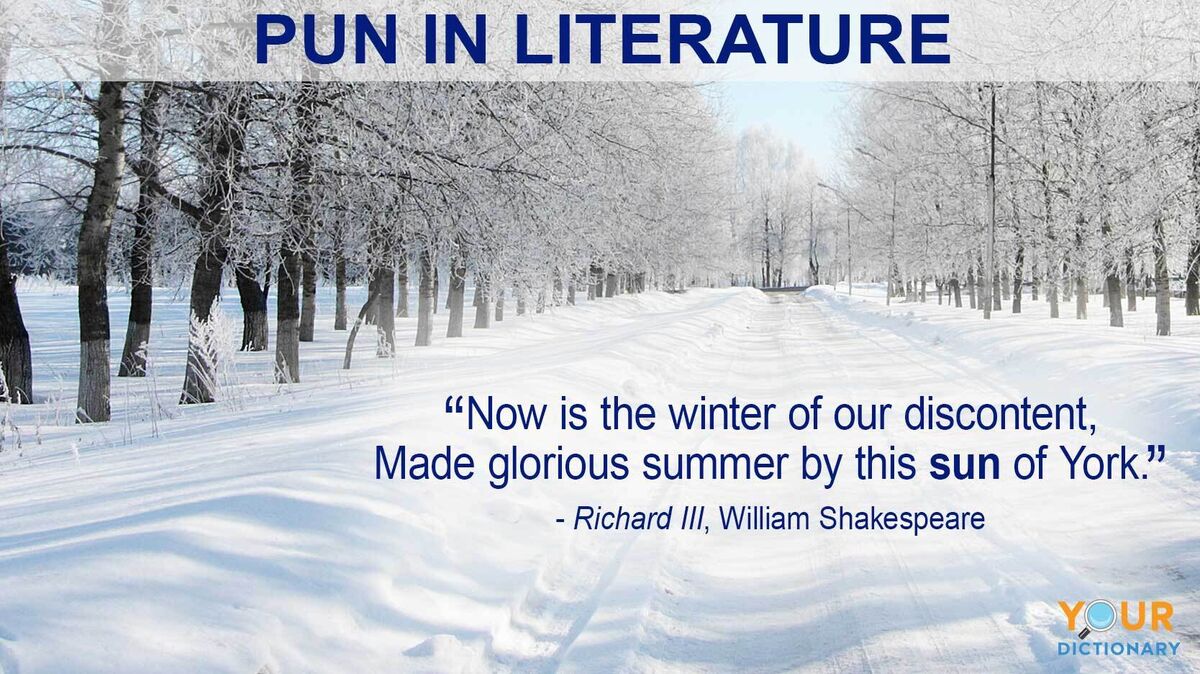
In the opening of Richard III, the sun refers to the blazing sun on Edward IV's banner and the fact that he is the son of the Duke of York:
"Now is the winter of our discontent
Made glorious summer by this sun of York."
In this line from Romeo and Juliet, Shakespeare plays on the different meanings of heavy (which also means sad) and light:
"Give me a torch: I am not for this ambling; Being but heavy I will bear the light."
Later in Romeo and Juliet, a morbid pun comes from a fatally-stabbed Mercutio, where grave means serious, but also alludes to his imminent death:
"Ask for me tomorrow, you shall find me a grave man."
If you open any Shakesperean play, you're likely to find at least one pun on the page! Keep an eye out for a clever play on words example the next time you read Hamlet or watch As You Like It on the stage.
Puns in Prose
Novels and plays also benefit from the addition of puns to add humor and give nuance to the story. There are many examples of puns in Lewis Carroll's Alice's Adventures in Wonderland, which help to convey the strangeness of Wonderland. Here Alice confuses "tale" and "tail:"
"'Mine is a long and a sad tale!' said the Mouse, turning to Alice, and sighing. 'It is a long tail, certainly,' said Alice, looking down with wonder at the Mouse's tail; 'but why do you call it sad?' And she kept on puzzling about it while the Mouse was speaking."
Madeleine L'Engle plays on the phrase "happy medium" in A Wrinkle in Time. It is also the name of a character who is a cheerful psychic living on a neutral planet. The phrase is said to Meg more than once, such as when Mrs. Murray says:
"A happy medium is something I wonder if you'll ever find."
A pun is built right into the title of Oscar Wilde's play The Importance of Being Earnest. In the beginning, the main character is neither earnest nor Ernest, but by the end of the play he is both:
"I've realized for the first time in my life the vital Importance of Being Earnest."
In this line from Great Expectations, Charles Dickens uses the different meanings of the word "point" to good effect:
"They seemed to think the opportunity lost, if they failed to point the conversation to me, every now and then, and stick the point into me."
Talented writers can use puns to elicit any emotion they want. A funny pun keeps the tone light, while a pointed (pun intended, a la Dickens) pun highlights a specific issue.
Puns in Poetry
Great poetic works have included interesting puns as well. John Donne often used puns in his poetry. In his "Hymn to God the Father," he plays with his name and the name of his wife, Anne More:
"When Thou hast done, Thou hast not done, For I have more."
Robert Frost was no stranger to wordplay. His pun in "But Outer Space" is both cheeky and clever as he compares the words "populace" and "populous:"
"But outer Space,
At least this far,
For all the fuss
Of the populace
Stays more popular
Than populous"
Ambrose Bierce makes a pun on Robert Browning's name in his poem "With a Book." Note the use of color words to make a point about Bierce's opinion of Browning's writing:
"Words shouting, singing, smiling, frowning —
Sense lacking.
Ah, nothing more obscure than Browning
Save blacking."
Harryette Mullen uses the multiple meanings of "slip" to good effect in her poem "Of a Girl in White:"
"Her starched petticoats giving him the slip."
Poetic puns are an effective way to bring more imagery into the poem. These examples of wordplay illustrate the multiple levels of these poems.
Biblical Puns
One of the oldest puns in the world comes from the book of Judges, which was written some 3,000 years ago. The tenth chapter of the book of Judges tells the tale of 30 sons, who "rode around on thirty burros and lived in thirty boroughs." While these words rhyme in English, they were also very similar in the original Hebrew: ayirim for burros and ayarim for boroughs.
Because the Bible was not originally written in English, not all puns in the text come across in translation. Most Christians are familiar with a pun attributed to Jesus, however, when he said, "Upon this rock I will build my church." He was speaking of Peter, whose name means "rock" in Greek (the similarity is still strong in Romance languages today).
Funny Puns About Literature
There are also many clever puns about authors and their works. These literary jokes rely on puns for their laughs:
- Why is John Milton terrible to invite to game night? Because when he's around, there's a pair of dice lost [Paradise Lost].
- What makes "Civil Disobedience" such a great essay? Thorough [Thoreau] editing.
- How did Voltaire like his apples? Candied [Candide].
- Charlotte Bronte is a breath of fresh air [Eyre].
You can come up with your own author-specific puns! Think of your favorite writer and their style, and see if there is a homophone that applies. Soon you'll be on the write track!
Grasp the Meaning
Puns are not just humorous, they can also make you pause and consider what you've read from a different angle, giving you a deeper appreciation for a writer's talent and grasp of the language. Authors have used puns over the centuries to entertain perceptive readers and make reading more interesting by injecting some clever word play. See more examples of funny puns that you'll want to include in conversation right away. Or for other examples of wordplay, try out 40 funny paraprosdokian sentences that will put a smile on your face.